

Kabir Helminski
I remember vividly my first impression of Asad Ali as he opened the door of his home. This “Arab ascetic” was dressed in a stylish white suit and greeted us with a broad smile and a flamboyant “Salaam! Salaam!” We were about to enter a new world of cultivated meaning, high conversation, and spiritual refinement. It is said that the high art of the Arab is rhetoric, and in Damascus, we witnessed a love of language and mystical discourse greater than anything we had so far experienced.
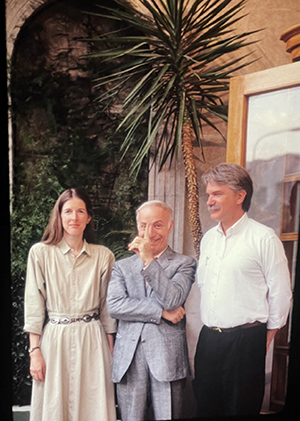
If our first week in Damascus were a book, I would call it The Seven Rivers of Damascus. Dr. Ali said to us one night, “Did you know that Damascus has seven great rivers?”
“No,” I said.
“Yes, you don’t know them because they’re not seen. They’re all underground,” he said playfully. Those seven rivers were the seven states of consciousness, the seven levels of spiritual awareness that the mystic experiences.
I can trace some of the most important realizations, or understandings, to that first week.
In traditional Sufism the soul passes through seven stages of transformation.
But for Asad Ali, Pure Spirit, the Love Absolute is in love with the self, and that mortal self is the beloved. Spirit loves self because it is through the self that all the Divine Attributes and Qualities are manifest in the world. And the human self is meant to love Spirit, because everything that is valuable and beautiful in the human being is sourced in Spirit. If the self loves only the self, apart from God, that is a sub-human state. That is what is meant by Hell.
That first week was also our introduction to the esoteric dimension of the Qur’an. Mawlana Asad lived and breathed the Qur’an and its linguistics. Everything in life, in the world, was but a reflection of the Qur’an, its vocabulary and syntax.
As a matter of fact, I had brought certain questions about the Qur’an, and one was, “Why does God say in the Qur’an that the human being is created from a ‘blood clot,’ or in some translations, simply ‘clot.” I was quoting the common English translation of the first words revealed to Prophet Muhammad, peace be upon him.
“Created from what! A clot? No, no. Created from alaq. This is the geometry of life, not a clot! Alaqa means to reach, connect to, or form a relationship with something. Alaq is a clinging substance, you might say, something that intertwines,” and he clasped the fingers of both hands to demonstrate.
“Ah, you mean like DNA?”
“Yes, for instance. And more! Allah is continually connecting, proportioning the circumstances of our lives.”
It was that week that I first dreamed in Arabic and my dream was a linguistic one. Two separate but similar sounding phrases.
Mutlaq, kitab, alayk.
Mutlaq. Qutub. Alaq.
And these could be translated as:
The absolute book for you.
The Absolute. The spiritual pole, or axis. The germ cell of life.
I understood the first phrase to mean that, while I had been a publisher at that point in my life, with only one short book of Rumi translations published in my name, that here I was being introduced to the Absolute Book, the Mother of the Book, as the Qur’an is called.
The second phrase was a cosmological key: God, the Absolute, is brought into the world through a spiritual axis that runs through all levels of existence, right down to the germ of life, alaq, which epitomizes the care with which the Divine tends to every detail of life.
More than any meaning or content that I could name from that first week, we left Damascus with a new energy. For the next year poems flowed through Camille non-stop like Rumi after meeting Shams—poems of the Divine Presence and Qualities. For me, on the other hand, I felt that I had been taken by the Divine Hand and put back on the Path I belonged to.
From Syria we went to Turkey where it seemed doors were opened to us everywhere we went. We were not only received back in the country which had been the origin of our Sufi connection, but now we were being introduced to new friends and connection to a very progressive Sufism, the colleagues and teachers that would be essential in this next phase of our spiritual journey.
Our closeness with Mawlana Asad would continue up to this day, even during the unfolding tragedies that have descended on our beloved Syria, but there were many occasions when Damascus and Asad Ali was the threshold where the two worlds met.
Very late one warm summer night as we sat among the trellised jasmine vines at Asad Ali’s yard, he seemed to go into an altered state and with eyes closed said in Arabic, “Name a Prophet.” I was startled but replied, “Seth.”
Dr. Ali didn’t seem to recognize what I was saying until one of the friends said, “Sheeth, Mawlana, Sheeth (the Arabic name for Seth).
“Azim (great)! It is Sheeth speaking to you,” and he recited the following words, which were transcribed by two other people sitting at the table.
They are the generous ones, and the fragrance spreads through generosity.
The incense of the Pleiades rests with the melody.
Greetings from my Father (Adam). And my Mother (Eve) sends her sunlight,
To bring together with the intimacy of lights, the Arabs and the non-Arabs.
O Son, the Song of Seth, as you see,
Has renewed rhythm, played on the strings of a breeze.
Glory be to my Lord, I wrote the song repeatedly with my tears,
So that the desert smiles and becomes verdant.
My father is Adam and his new descendants, are still born among you,
Through Moses and the Master of the Cave, and the wind is still alert.
The breeze repeats our yearning greetings for you,
As if Love is being interpreted for the sake of nations.
The safety of my Mother recalls your conversation through her,
Glorified Gracious God, the shining of the Most Merciful.
The eyelids bestow mercy upon the Childhood of their light
And a vow was made in the Himalayas of good taste
To the Bestower of Grace, the Possessor of the Most Beautiful Names,
Still circulating as if from a point out of which oceans spread into existence.
I love my father and mother and I speak of spiritual law,
and throne, and footstool, and the movement of the Pen[1].
The highest morals are those of Muhammad, and his family members
Are like flying flags, and the happy one is whoever catches this fragrance.
Is it enough and would they be satisfied with my greetings,
And the greetings of those who prayed to spare them the pain with the Love I have.
The vines of the cluster of talents are granted.
They are generous ones, and the fragrance spreads through generosity.
Receiving this message in the form of a poem from the Prophet Seth[2], one of the earliest in the lineage of Prophets, was like a confirmation of being received into a relationship with the primordial religion of humanity. It has oriented us ever since to the Sustainer of Life, the Source of our consciousness and love, a unified field of continuous Presence.
In subtle stages I awoke
and saw my life
was not my life,
I belonged to Life itself.
My will wasn’t my will
but an instrument
in a symphony
I began to hear.
The music was sometimes sorrowful, sometimes powerfully joyous. A musical universe? Yes, always music.
I stopped “believing” in “a God.” I discovered a field of intelligence, a self-reflective universe of qualities, a Love always seeking to be known, to be manifest to Itself.
[1] These are cosmological symbols signifying levels of unmanifest and manifest Being.
[2] Seth, a Prophet like his father Adam, transfers God’s Law to mankind after the death of Adam and places him among the exalted antediluvian patriarchs of the Generations of Adam. Adam is not understood through a Creationist lens, but rather as the first truly conscious human being. Some sources say that Seth was the receiver of revelation. These scriptures are said to be the “first scriptures” mentioned in Q 87:18. Medieval historian and exegete al-Tabari and other scholars say that Seth buried Adam and the secret texts in the tomb of Adam, i.e., the “Cave of Treasures.”